
The proposed facility seeks to simplify and speed up PF withdrawals by allowing Employees' Provident Fund Organisation (EPFO) subscribers to access up to 75 per cent of their balance through ATMs and UPI-based systems, while retaining at least 25 per cent in their accounts.

Chinese President Xi Jinping warned US President Donald Trump that mishandling the Taiwan issue could trigger conflicts between the two countries during wide-ranging talks on trade, Iran, and energy security.

This sharp Iranian response came after a series of uncompromising remarks from the US president.

The 2026 Asian Senior Weightlifting Championships, featuring participants from approximately 30 nations, commenced in Gandhinagar, highlighting India's growing role in international sports.

Foreign investors have aggressively sold off Indian equities, withdrawing over 48,213 crore in the first 10 days of April, following a record 1.17 lakh crore outflow in March, driven by escalating geopolitical tensions in West Asia, rising crude oil prices, and global inflation concerns.

The Trump administration maintains the US is 'not at war' with Iran, despite military engagement reaching a critical legal threshold under the War Powers Resolution, potentially leading to a confrontation with Congress.

Prime Minister Narendra Modi has called on Indian citizens to unite and overcome the challenges posed by the ongoing conflict in West Asia, cautioning against politicisation and rumour-mongering.

Indian equity benchmark indices, Sensex and Nifty, tumbled nearly 2 per cent for the fourth consecutive session, driven by elevated crude oil prices, escalating US-Iran tensions, unabated foreign fund outflows, and a depreciating rupee.
Indian equity benchmark indices, Sensex and Nifty, tumbled nearly 2 per cent for the fourth consecutive session, driven by elevated crude oil prices, escalating US-Iran tensions, unabated foreign fund outflows, and a depreciating rupee.

History is rarely decided by who has the biggest weapons, but by who has the better process. The same rule applies to investing, says Ramalingam Kalirajan.

India has expressed strong concerns over attacks on commercial ships in the Strait of Hormuz, citing its importance to India's energy and economic security. Ambassador Yojna Patel highlighted the need to respect international law and ensure the safety of seafarers, while also addressing broader Middle East issues including the situation in Gaza and Lebanon.
Foreign Ministers from Pakistan, Saudi Arabia, Turkiye, and Egypt convened in Antalya to explore avenues for enhanced cooperation across various sectors of mutual interest, reaffirming their commitment to regional peace and stability.

Jewellers in Lucknow protest Prime Minister Modi's appeal to defer gold purchases for a year amid the West Asia crisis, fearing significant business losses and economic hardship for those involved in the trade.

Airfares to Southeast Asia have surged 25 to 30 per cent, driven by high demand and limited airline seat capacity.
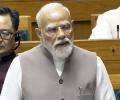
Modi said that the West Asia crisis has been going on now for more than three weeks and is having a very adverse impact on the global economy and on people's lives. He said the entire world is urging all parties for the earliest resolution of this crisis.

It seems odd to criticise a country for delivering growth rates in standards of living and consumption that have been perhaps the fastest, longest, and most broad-based (affecting hundreds of millions of people) in history, points out Arvind Subramanian.

Nobody takes Pakistan seriously and therefore Pakistan's sudden mediating with almost immediate results of a ceasefire seems more contrived than real, points out Vice Admiral Biswajit Dasgupta (retd).

The Indian government has waived customs duty on critical petrochemical products until June 30 to ensure supply stability and provide relief to consumers amid disruptions caused by the crisis in West Asia.
India's services sector growth reached a five-month high in April, with the HSBC India Services PMI Business Activity Index rising to 58.8, primarily driven by robust domestic demand and a shift from international to local suppliers amidst the West Asia crisis.

An analysis of the disparities in India's sporting culture, highlighting the challenges faced by non-cricket athletes and the systemic changes needed for India to become a true sporting superpower.
Live updates on the US-Israel-Iran war: Trump escalates threats, Iran retaliates, and oil prices surge as the Strait of Hormuz crisis disrupts global markets.

US Secretary of State Marco Rubio arrived in Kolkata for a four-day diplomatic tour to India, marking the first visit by a US secretary of state to the city in 14 years. His itinerary includes meetings with Indian officials, energy talks, and a Quad Foreign Ministers Meeting.
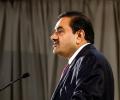
Gautam Adani, chairman of Adani group, emphasised that energy and intelligence are inseparable national priorities, asserting that India must build its own capabilities in these sectors rather than relying on external sources, especially in the context of global conflicts and shifting supply chains.
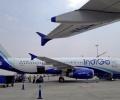
IndiGo airline will face near-term pressure on profitability from rising fuel prices following the escalation of conflict in West Asia, though it is likely to pass on higher costs to passengers over time because its ticket booking cycle is relatively short, according to a report by Moody's Ratings.

The OECD projects India's GDP to grow at 7.6% in the current fiscal year and 6.1% in 2026-27, despite global economic challenges stemming from the Middle East conflict and energy price volatility.

External Affairs Minister S Jaishankar discussed the West Asia conflict and its impact on energy supplies with his Russian counterpart Sergey Lavrov and EU's Foreign Policy chief Kaja Kallas.

The Indian government has increased the export duty, or windfall tax, on diesel to Rs 55.5 per litre and on aviation fuel (ATF) to Rs 42 a litre, effective immediately, to boost domestic availability and prevent exporters from exploiting global price differences.
India addresses the escalating conflict in West Asia, outlining its diplomatic efforts to ensure energy security, the safety of its citizens, and advocating for a peaceful resolution through dialogue.

Prime Minister Narendra Modi will review the impact of the West Asia conflict on India's food, energy, and fuel security with senior cabinet ministers. The meeting follows previous discussions and concerns raised about global energy crises and supply chain disruptions.
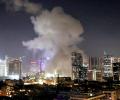
Disciplined investors who ignore short-term fear build significant long-term wealth, notes Ramalingam Kalirajan

The US-China rapprochement, however tenuous, is not without implications for India. Both China and Pakistan have become closer to the US, notes Ambassador T P Sreenivasan.

West Asia conflict triggers sharp sell-off in Indian markets, with realty, banking and auto stocks leading losses amid energy shock fears.
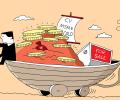
Several non-banking financial companies (NBFCs) are observing an increase in early-stage delinquencies within their micro, small and medium enterprises (MSME) loan portfolios, primarily driven by supply chain disruptions and escalating raw material costs exacerbated by the ongoing conflict in West Asia.
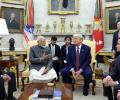
Prime Minister Narendra Modi and US President Donald Trump discussed the Middle East crisis, with a focus on the Strait of Hormuz.
US President Donald Trump and Chinese President Xi Jinping began a crucial two-day summit in Beijing on Thursday, with both leaders signalling a desire to stabilise relations between the world's two biggest economies despite deep disagreements on trade, Taiwan, technology and security issues.

Trump said that the strait will be "open very soon" if ongoing negotiations with Tehran continue successfully.

Aviation fuel prices for domestic airlines remain unchanged, providing stability for local carriers, while commercial LPG and 5-kg cylinders see a significant rate hike due to rising international energy costs.
Global energy markets saw a significant correction as oil prices nosedived following Iran's announcement that the Strait of Hormuz has been fully reopened, dismantling the 'war-risk' premium that had gripped the market.

The ongoing conflict involving the United States, Israel, and Iran intensified sharply with attacks on critical energy infrastructure across the Gulf, even as US President Donald Trump said he had cautioned Israeli Prime Minister Benjamin Netanyahu against targeting Iran's key South Pars Gas Field.

One Indian oil tanker successfully crossed the Strait of Hormuz, while others turned back after Iran signalled the waterway's closure, amidst rising tensions and disruptions to global energy flows.
